
Introduction
Unsupervised learning is an important branch of machine learning that helps computers discover hidden patterns in data. It works with unlabeled data, meaning the information does not have predefined categories or answers. This technique allows machines to identify similarities, differences, and relationships independently. It is widely used in business, healthcare, marketing, data analysis, and many other fields. Understanding unsupervised learning helps us see how computers turn raw data into useful insights.
1. What Is Unsupervised Learning?
Unsupervised learning is a machine learning technique that enables computers to analyze data without labeled examples. Instead of receiving correct answers during training, the algorithm explores the data to find meaningful structures. It can group similar records, identify unusual observations, and discover relationships between different variables. For example, an online store can use this method to group customers according to their shopping habits. These groups help businesses understand customer behavior and make better decisions. The main purpose is to discover useful information that may not be obvious at first glance. Unlike supervised learning, this approach does not depend on predefined output labels. It is particularly helpful when working with large datasets that have not been manually categorized.
2. How Does Unsupervised Learning Work?
Unsupervised learning begins by collecting data from different sources, such as websites, applications, surveys, or business records. The collected information is then prepared by removing errors, handling missing values, and organizing relevant features. After preparation, an appropriate algorithm examines the data to identify similarities, differences, or recurring patterns. Depending on the method, the algorithm may create groups, reduce the number of features, or detect unusual observations. The results are evaluated to determine whether the discovered patterns are meaningful and useful. For example, customer purchase records may reveal several groups with different spending habits. Data visualization can help analysts understand these patterns more clearly. The final results can support research, planning, forecasting, and practical decision-making.
3. Types of Unsupervised Learning
Unsupervised learning includes several techniques designed to solve different data analysis problems. Clustering is used to divide data points into groups based on their similarities. Association rule learning identifies relationships between items or events that frequently occur together. Dimensionality reduction simplifies complex datasets while preserving important information. Anomaly detection focuses on finding observations that differ significantly from normal patterns. Each technique has its own strengths and is suitable for particular tasks. For instance, clustering can help identify customer segments, while dimensionality reduction can simplify image data. Choosing the right technique depends on the dataset, the problem, and the desired outcome.
4. Clustering in Unsupervised Learning
Clustering is one of the most commonly used methods in unsupervised learning. It organizes data into groups so that similar observations are placed closer together. The K-means algorithm is a popular clustering technique that divides data into a selected number of clusters. Hierarchical clustering builds a structure of groups that can be examined at different levels. DBSCAN identifies clusters based on data density and can also recognize certain points as noise. Businesses often use clustering to divide customers according to their interests, purchases, or spending behavior. Researchers may also apply it to organize documents, analyze biological data, or study geographic patterns. The quality of the resulting clusters depends on the data, selected features, and algorithm settings.
5. Association Rule Learning
Association rule learning discovers connections between items that frequently appear together in a dataset. It is commonly used in retail, online shopping, and recommendation systems. For example, a supermarket may discover that customers who purchase pasta often buy tomato sauce as well. The Apriori algorithm is a well-known method for identifying frequent item combinations. Another technique, FP-Growth, finds frequent patterns using a different and often more efficient approach. Measures such as support, confidence, and lift help analysts evaluate association rules. These findings can support product placement, promotional planning, and personalized recommendations. However, a discovered association does not automatically mean that one item causes the purchase of another.
6. Dimensionality Reduction
Dimensionality reduction decreases the number of variables in a dataset while retaining as much useful information as possible. It is especially valuable when datasets contain hundreds or thousands of features. A large number of features can make analysis more complicated and increase computational requirements. Principal Component Analysis, commonly known as PCA, is a widely used dimensionality reduction technique. It transforms correlated variables into a smaller set of components that capture important variation. Another method, t-SNE, is frequently used to visualize high-dimensional data in two or three dimensions. These techniques can make complex datasets easier to explore and interpret. Nevertheless, reducing dimensions may cause some information to be lost, so the results require careful evaluation.
7. Anomaly Detection
Anomaly detection identifies data points that differ considerably from the usual behavior or structure of a dataset. These unusual observations may indicate errors, unexpected events, or potentially suspicious activities. Banks can use anomaly detection to flag transactions that differ from typical spending patterns. Manufacturing companies may apply it to identify equipment behavior that could signal a developing fault. Algorithms such as Isolation Forest and Local Outlier Factor can help detect unusual observations. The meaning of an anomaly depends on the context and the characteristics of the data. Not every unusual observation represents a problem, and some legitimate activities may appear abnormal. For this reason, findings should be reviewed carefully before important decisions are made.
8. Applications of Unsupervised Learning
Unsupervised learning has many practical applications across different industries. In marketing, it helps businesses identify customer segments and understand purchasing preferences. In healthcare research, it can reveal patterns in patient records and biological datasets. Cybersecurity teams may use it to identify unusual network activity or suspicious behavior. Financial institutions can apply these techniques to explore transaction patterns and investigate potential irregularities. Search engines and content platforms may use clustering methods to organize related information. Scientists can also use unsupervised learning to explore large datasets and generate new research questions. Its flexibility makes it useful whenever data contains patterns that are difficult to identify manually.
9. Advantages of Unsupervised Learning
One major advantage of unsupervised learning is that it does not require manually labeled training examples. This can save time and reduce the cost of preparing large datasets. It can uncover hidden relationships that people might overlook during traditional analysis. The method is useful for exploring unfamiliar datasets when the expected results are not known in advance. It can also help organizations understand customers, identify unusual behavior, and organize complex information. Some techniques provide valuable visual representations of data that improve understanding. Furthermore, unsupervised methods can complement supervised learning during data exploration and feature preparation. Their overall value depends on the quality of the data and how effectively the findings are interpreted.
10. Challenges and Limitations of Unsupervised Learning
Despite its benefits, unsupervised learning presents several challenges. Since the data lacks predefined labels, it can be difficult to determine whether the results are correct. Different algorithms may discover different patterns in the same dataset. The quality of the output can also be affected by missing values, irrelevant features, and measurement errors. Some methods require careful selection of parameters, such as the number of clusters. Interpreting the results may require technical knowledge and an understanding of the subject area. Algorithms can also identify misleading patterns that do not provide practical value. Careful preprocessing, evaluation, and expert review are essential for obtaining reliable results.
11. Difference Between Supervised and Unsupervised Learning
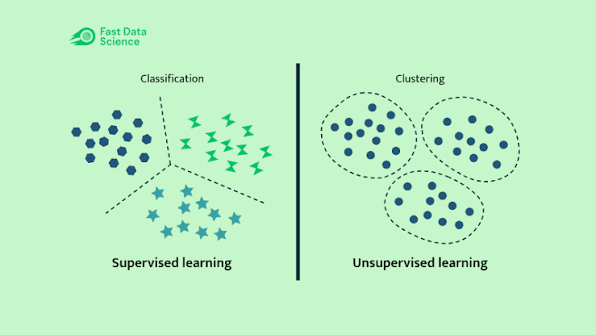
Supervised and unsupervised learning are two major approaches in machine learning, but they serve different purposes. Supervised learning uses labeled data, where examples include known outputs or target values. Unsupervised learning uses data without predefined target labels to discover underlying structures. Classification and regression are common supervised learning tasks. Clustering, association rule learning, and dimensionality reduction are common unsupervised learning tasks. For example, supervised learning can predict house prices using historical examples with known prices. Unsupervised learning can group houses according to similar characteristics without predefined categories. The choice between these approaches depends on the available data and the objective of the project.
12. Future of Unsupervised Learning
The future of unsupervised learning is closely connected to the growing availability of digital data. Organizations increasingly need methods that can analyze large amounts of information with limited manual labeling. Advances in deep learning are expanding the ability to discover complex patterns in text, images, audio, and video. Self-supervised learning is also gaining importance by creating learning signals from the structure of the data itself. These developments support progress in language technologies, scientific research, robotics, and intelligent applications. However, reliable results will continue to depend on data quality, appropriate evaluation, and responsible use. Researchers are working to improve the efficiency, interpretability, and robustness of learning algorithms. As these methods develop, unsupervised learning is likely to remain an important part of modern data science.
Conclusion
Unsupervised learning enables computers to discover patterns and relationships without relying on labeled training data. Its main techniques include clustering, association rule learning, dimensionality reduction, and anomaly detection. These methods help organizations analyze complex information and identify useful insights. Although challenges such as interpretation and data quality remain, careful evaluation can improve their effectiveness. Overall, unsupervised learning plays a valuable role in machine learning and continues to support innovation across many industries.
Frequently Asked Questions (FAQs)
1. What is the main purpose of unsupervised learning?
The main purpose of unsupervised learning is to discover hidden patterns, similarities, and relationships in unlabeled data. It helps analysts understand information without relying on predefined answers.
2. What are the most common algorithms used in unsupervised learning?
Common algorithms include K-means, hierarchical clustering, DBSCAN, Apriori, Principal Component Analysis (PCA), and Isolation Forest. Each algorithm is designed for specific tasks, such as grouping data, finding associations, reducing dimensions, or detecting anomalies.
3. Where is unsupervised learning used in real life?
Unsupervised learning is used in customer segmentation, fraud investigation, cybersecurity, healthcare research, product recommendations, and scientific data analysis. It helps identify meaningful patterns that can support better decisions.