
Introduction
Model optimization is an important process for improving the performance and efficiency of different types of models.
It helps reduce unnecessary complexity while maintaining accuracy and reliability.
Businesses and developers use optimization techniques to achieve better results with fewer resources.
This process is valuable in machine learning, artificial intelligence, mathematics, and data analysis.
Understanding model optimization can help individuals build faster, smarter, and more efficient solutions.
1. What Is Model Optimization?
Model optimization refers to the process of improving a model so that it performs its intended task more effectively. It involves adjusting parameters, simplifying structures, and reducing unnecessary calculations. In machine learning, optimization often focuses on minimizing errors and improving predictive accuracy. A well-optimized model can process information efficiently without requiring excessive computing power. The main objective is to achieve the best possible performance while balancing speed, accuracy, and resource consumption. Depending on the application, optimization may involve improving training, inference, or the overall model architecture. It is an essential part of developing reliable and practical AI systems.
2. Importance of Model Optimization
Model optimization plays a significant role in modern technology because it helps improve the quality and efficiency of computational systems. Large models may require considerable memory, processing power, and energy to operate. Optimization techniques can reduce these requirements and make advanced tools more accessible. For businesses, this may lead to lower operating costs and faster services. Researchers can also benefit from optimized models when conducting experiments or processing large datasets. In addition, optimization can improve the user experience by reducing delays and making applications more responsive. These benefits make optimization an important consideration throughout the model development process.
3. Model Optimization in Machine Learning
In machine learning, model optimization is closely connected to the process of training algorithms to learn patterns from data. During training, a model makes predictions, compares them with expected results, and adjusts its parameters to reduce errors. Optimization algorithms help determine how these adjustments should occur. Common approaches include gradient descent and its variations, which update model parameters based on calculated gradients. The effectiveness of this process depends on the dataset, model architecture, learning rate, and selected optimization method. Proper optimization can help a model learn meaningful relationships without wasting computational resources. It also contributes to developing models that perform well on previously unseen data.
4. Common Model Optimization Techniques
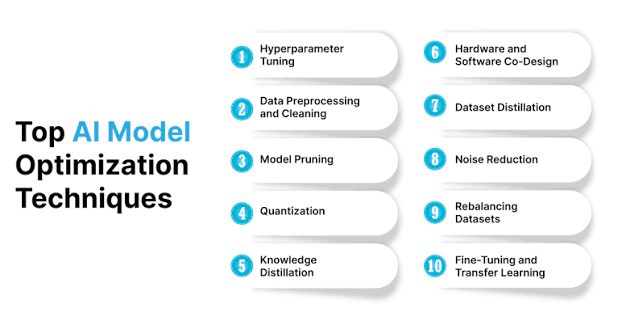
Several techniques can be used to improve model performance, depending on the problem and available resources. Hyperparameter tuning involves testing different settings to identify combinations that produce better results. Feature selection removes irrelevant or redundant input variables, helping simplify the learning process. Regularization can reduce overfitting by discouraging excessive model complexity. Pruning removes less important connections or components from certain models, particularly neural networks. Quantization reduces the precision used to represent model values, which can lower memory requirements and improve inference speed. Each technique offers different advantages, so developers should select methods according to their specific goals and technical limitations.
5. The Role of Hyperparameter Tuning
Hyperparameter tuning is an important part of model optimization because it helps determine suitable training settings. These settings may include the learning rate, batch size, number of training iterations, and model complexity. Poor choices can result in slow learning, unstable training, or unsatisfactory predictions. Developers can explore different configurations through grid search, random search, or more advanced optimization methods. Validation data is commonly used to compare candidate configurations before final evaluation. The process requires careful planning because testing too many combinations can consume significant time and computing power. Effective tuning helps create a better balance between predictive performance, training time, and model complexity.
6. Model Optimization and Artificial Intelligence
Artificial intelligence systems often rely on complex models that process large amounts of information. Model optimization helps these systems operate more efficiently in practical environments. For example, an optimized language model may generate responses more quickly, while an optimized computer vision model may identify objects using fewer resources. Optimization can also make AI applications more suitable for smartphones, embedded devices, and other systems with limited computing capacity. However, reducing model size or computational requirements must not significantly damage output quality. Developers should evaluate both performance and reliability when selecting optimization techniques. This balance is essential for creating AI solutions that are useful, affordable, and scalable.
7. Reducing Computational Costs
Computational cost is a major concern when training and deploying sophisticated models. High resource consumption can increase electricity usage, cloud computing expenses, and hardware requirements. Model optimization addresses these challenges by reducing unnecessary operations and improving the use of available resources. Techniques such as quantization, pruning, efficient architecture design, and hardware-aware optimization can help lower computational demands. In some situations, smaller models can provide sufficient accuracy without the expense of larger alternatives. Organizations should compare the cost of optimization with the benefits it provides. A thoughtful approach can improve operational efficiency while making machine learning projects more financially sustainable.
8. Preventing Overfitting Through Optimization
Overfitting occurs when a model learns the training examples too closely and performs poorly on new data. This problem can reduce the reliability of predictions in real-world situations. Model optimization helps address overfitting through techniques such as regularization, dropout, early stopping, and appropriate feature selection. Using a representative dataset and evaluating results on separate validation data can also reveal whether a model generalizes effectively. It is important to distinguish between training performance and actual predictive ability. A model that achieves excellent training accuracy may still fail when circumstances change. The goal is to develop a model that identifies useful patterns rather than simply memorizing examples.
9. Model Optimization for Deep Learning
Deep learning models often contain many layers and parameters, making their training and deployment computationally demanding. Optimization techniques help improve how these networks learn and operate. Algorithms such as Adam and stochastic gradient descent are widely used to update neural network parameters during training. Other methods, including mixed-precision training, pruning, and quantization, can improve efficiency in suitable environments. Architecture improvements may also reduce unnecessary calculations without sacrificing too much accuracy. The best approach depends on the network, hardware, dataset, and intended application. By carefully measuring performance, developers can make deep learning systems more practical for real-world use.
10. Challenges in Model Optimization
Although model optimization offers many benefits, it also presents several challenges. Reducing model complexity can sometimes lower accuracy or remove information that is important for predictions. Certain optimization methods require additional experiments, specialized knowledge, or compatible hardware. Results may also vary depending on the dataset and operating environment. Another challenge is selecting appropriate evaluation metrics, since improvements in speed do not always translate into better overall performance. Developers must consider factors such as reliability, fairness, memory consumption, and inference latency. Testing models under realistic conditions can help identify potential weaknesses. A balanced optimization strategy should improve efficiency while preserving the qualities required for the intended task.
11. Tools Used for Model Optimization
Various tools and frameworks support the optimization of machine learning and artificial intelligence models. Libraries such as PyTorch and TensorFlow provide facilities for training, profiling, and improving model performance. ONNX Runtime supports optimized model inference across compatible environments, while TensorRT offers performance optimization for supported NVIDIA hardware. Other tools help developers measure memory usage, computational requirements, and execution speed. The appropriate choice depends on the model architecture, deployment platform, and programming environment. Using these tools can make it easier to identify performance bottlenecks and test improvements systematically. Developers should always verify that an optimized model produces acceptable results on the target system.
12. Future of Model Optimization
The future of model optimization is closely connected to the growing demand for efficient and accessible artificial intelligence. Researchers are exploring smaller architectures, improved training algorithms, hardware-aware techniques, and methods that reduce energy consumption. These developments may allow advanced models to operate effectively on a wider range of devices. Automated optimization is also becoming increasingly useful because it can help identify effective configurations with less manual effort. At the same time, developers will need to maintain strong standards for accuracy, safety, and reliability. As AI applications expand into more industries, efficient models will become increasingly valuable. Continued progress in optimization can help make advanced technology more practical and sustainable.
Conclusion
Model optimization is essential for improving the efficiency, speed, and reliability of computational models.
It helps developers balance predictive accuracy with memory usage, processing time, and operating costs.
Techniques such as hyperparameter tuning, regularization, pruning, and quantization serve different optimization goals.
The right approach depends on the model, dataset, hardware, and intended application.
By evaluating results carefully, developers can build efficient models that deliver dependable performance in real-world situations.
Frequently Asked Questions (FAQs)
1. What is model optimization in simple terms?
Model optimization is the process of improving a model so that it performs its task more efficiently or accurately. It may involve adjusting parameters, simplifying the model, or reducing computational requirements.
2. Why is model optimization important?
It can improve processing speed, reduce memory usage, lower computing costs, and help models perform more reliably. It is particularly useful when deploying machine learning systems in resource-limited environments.
3. Which techniques are commonly used for model optimization?
Common techniques include hyperparameter tuning, gradient-based optimization, regularization, feature selection, pruning, and quantization. The best technique depends on the model’s purpose and performance requirements.