
Introduction
In today’s digital world, data plays an important role in almost every industry. Businesses use data to understand customer behavior, doctors analyze medical information to improve patient care, and financial institutions study market trends to make better decisions. But how can we turn large amounts of raw data into useful information? This is where statistical learning becomes valuable.
Statistical learning is a field of study that focuses on understanding data, identifying meaningful patterns, and making predictions based on statistical methods. It combines ideas from statistics, mathematics, and computer science to help people solve real-world problems. Whether we want to predict house prices, identify potential diseases, or understand why customers leave a service, statistical learning provides practical tools for analyzing information.
Although the concept may sound complicated at first, its basic idea is simple: learn from existing data to better understand or predict something that has not yet happened. In this article, we will explore what statistical learning means, how it works, its main types, common techniques, practical applications, benefits, and limitations.
What Is Statistical Learning?
Statistical learning is a collection of methods used to study relationships between variables in a dataset. These methods help researchers and analysts understand how different factors influence an outcome and how the information can be used to make predictions.
For example, imagine a real estate company that wants to estimate the price of a house. The price may depend on several factors, including location, size, number of bedrooms, property age, and nearby facilities. By studying information about previously sold houses, a statistical learning model can identify relationships between these factors and property prices.
The model can then use those relationships to estimate the value of another house.
Statistical learning is closely related to machine learning, but the two fields often emphasize different goals. Statistical learning traditionally places considerable importance on understanding relationships, measuring uncertainty, and interpreting results. Machine learning often focuses more heavily on predictive performance and the ability to process complex datasets. In practice, however, the two fields overlap significantly and share many techniques.
How Does Statistical Learning Work?
The statistical learning process usually begins with a clear question or problem. Before choosing a method, it is important to understand what the analysis should accomplish.
For instance, a business might want to know which factors influence customer satisfaction or whether a customer is likely to cancel a subscription.
The process generally involves several steps.
1. Collecting Relevant Data
The first step is gathering information related to the problem. Data may come from surveys, business records, experiments, public databases, sensors, or online platforms.
The quality of the collected data matters because incomplete, inaccurate, or biased information can lead to misleading results.
2. Cleaning and Preparing the Data
Raw data often contains missing values, duplicate records, inconsistent formats, and other errors. Before analysis begins, these problems need to be addressed.
Researchers may also transform variables, organize categories, or select relevant features to make the dataset suitable for modeling.
3. Choosing a Statistical Learning Method
The next step is selecting a method that matches the research question. Linear regression may be appropriate for predicting numerical values, while logistic regression can help estimate the probability of a binary outcome.
More complex problems may require decision trees, support vector machines, or other learning algorithms.
4. Training the Model
During training, the selected method uses existing data to estimate relationships or identify patterns. The model adjusts its parameters to represent the information contained in the training dataset.
The objective is to develop a model that captures meaningful patterns rather than simply memorizing individual observations.
5. Evaluating Performance
A model should be tested on data that was not used to train it. This helps determine whether it can perform well on new observations.
Depending on the problem, analysts may measure prediction errors, accuracy, precision, recall, or other performance indicators.
6. Interpreting and Applying the Results
Finally, the results are examined and used to support decisions. Analysts may explain which variables matter most, estimate future outcomes, or identify areas that deserve further investigation.
A useful model should not only produce results but also provide information that makes sense within the context of the problem.
Main Types of Statistical Learning
Statistical learning is commonly divided into two major categories: supervised learning and unsupervised learning. Each category serves a different purpose.
Supervised Learning
Supervised learning uses labeled data, meaning the dataset contains both the input information and the known outcome. The model learns from these examples and uses the learned relationships to predict outcomes for new observations.
There are two common forms of supervised learning.
Regression: Regression methods predict numerical outcomes. For example, a company might estimate monthly sales based on advertising expenditure, seasonal patterns, and previous sales figures.
Classification: Classification methods assign observations to categories. A bank might use classification to identify transactions that appear potentially fraudulent, while an email service might classify incoming messages as spam or legitimate.
Supervised learning is especially useful when historical examples with known outcomes are available.
Unsupervised Learning
Unsupervised learning works with data that does not have predefined outcome labels. Instead of predicting a known target, the model attempts to discover patterns, groups, or structures within the information.
One common technique is clustering. A retail company, for example, might group customers according to purchasing habits, spending levels, and product preferences. These groups can help the company develop more relevant marketing strategies.
Another technique is dimensionality reduction, which simplifies datasets containing many variables while attempting to preserve important information.
Unsupervised learning is helpful when researchers want to explore unfamiliar data or identify relationships that were not obvious beforehand.
Common Statistical Learning Techniques
Several methods are widely used in statistical learning. The most appropriate choice depends on the dataset, the objective, and the level of complexity involved.
Linear Regression
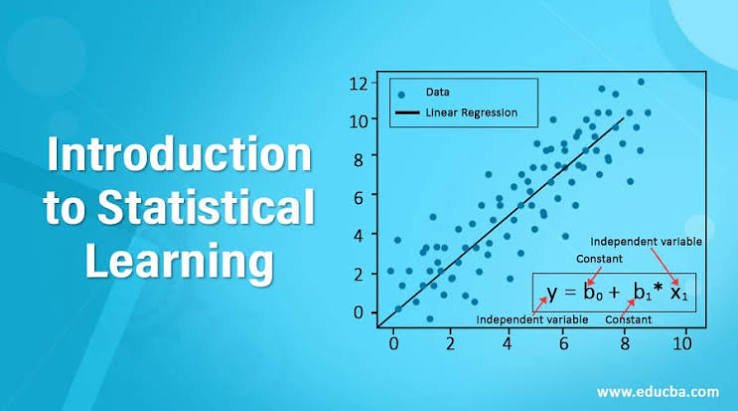
Linear regression estimates the relationship between a numerical outcome and one or more explanatory variables. It is often used for forecasting, trend analysis, and understanding how changes in one factor relate to another.
Its main advantage is interpretability. However, a simple linear model may not adequately represent relationships that are highly nonlinear.
Logistic Regression
Logistic regression is commonly used for classification problems, particularly when the outcome has two categories. It estimates the probability that an observation belongs to a particular class.
Applications include predicting customer churn, assessing loan default risk, and supporting medical risk assessments.
Decision Trees
Decision trees make predictions by dividing data into smaller groups based on selected conditions. Their structure resembles a flowchart, which makes them relatively easy to understand.
For example, a decision tree might classify a customer according to purchase history, account activity, and subscription length. However, an overly complex tree can fit training data too closely and perform poorly on new information.
Random Forests
Random forests combine predictions from multiple decision trees. This approach can improve predictive performance and reduce some of the instability associated with individual trees.
They are useful for many classification and regression tasks, particularly when relationships between variables are complex.
Support Vector Machines
Support vector machines attempt to separate different classes by identifying an effective decision boundary. With suitable kernels, they can also model nonlinear relationships.
These methods can perform well on certain high-dimensional datasets, although selecting suitable parameters may require careful experimentation.
Regularization Methods
Regularization techniques, such as ridge regression and lasso regression, help control model complexity by penalizing large or unnecessary coefficients.
They are especially useful when a dataset contains many related variables or when there is a risk of overfitting.
Real-World Applications of Statistical Learning
Statistical learning is useful across a wide range of industries because organizations constantly need to understand data and make informed predictions.
Healthcare
Healthcare professionals and researchers use statistical learning to study disease risk, analyze medical images, and identify patterns in patient records. These methods can support clinical research and decision-making, although medical predictions require careful validation and professional oversight.
Finance and Banking
Banks and financial institutions apply statistical learning to credit risk assessment, fraud detection, and financial forecasting. Models can identify unusual transaction patterns and estimate the likelihood of certain financial outcomes.
Marketing and Business
Companies use statistical learning to understand customer preferences, predict demand, estimate sales, and evaluate marketing campaigns. These insights can help businesses allocate resources more effectively.
Education
Educational institutions can analyze student performance, attendance, and engagement to identify students who may need additional support. Such models should be used carefully to avoid unfair labeling or reinforcing existing inequalities.
Transportation and Logistics
Transport companies use predictive models to estimate delivery times, forecast demand, and improve route planning. These applications can reduce delays and support more efficient operations.
Environmental Research
Researchers use statistical learning to analyze weather observations, monitor pollution, study biodiversity, and investigate environmental changes. These methods can help identify trends across large and complex datasets.
Benefits of Statistical Learning
One of the biggest advantages of statistical learning is its ability to turn large datasets into useful insights. Instead of relying entirely on intuition, organizations can examine evidence and make more informed decisions.
Another benefit is improved prediction. When a model captures meaningful patterns and performs well on new data, it can help estimate future outcomes and identify potential risks.
Statistical learning also supports automation. Repetitive analytical tasks, such as categorizing records or identifying unusual transactions, can be performed more efficiently with suitable models.
Interpretability is another important advantage of many statistical methods. Techniques such as linear regression can help users understand how variables relate to an outcome, making the results easier to communicate.
Finally, statistical learning encourages evidence-based thinking. By measuring uncertainty, evaluating model performance, and testing assumptions, analysts can develop a more careful understanding of the problems they investigate.
Challenges and Limitations of Statistical Learning
Despite its benefits, statistical learning has several limitations.
The first challenge is data quality. If the training dataset contains errors, missing information, or systematic bias, the resulting model may produce unreliable predictions.
Overfitting is another common problem. It occurs when a model learns the specific details and noise of its training data instead of capturing patterns that generalize to new observations. As a result, the model may perform well during training but poorly in real-world situations.
Model interpretation can also become difficult when complex algorithms are used. Although a model may generate accurate predictions, understanding exactly why it produced a particular result can be challenging.
Another concern is that statistical relationships do not automatically establish causation. For example, two variables may move together because of a third factor rather than because one directly influences the other.
Privacy, fairness, and responsible data use are equally important. Organizations should protect sensitive information, examine potential biases, and evaluate how automated decisions affect different groups.
These challenges can be addressed partly through careful data preparation, appropriate model selection, independent testing, regular monitoring, and transparent reporting.
Statistical Learning vs. Machine Learning
Statistical learning and machine learning share many concepts, including regression, classification, model evaluation, and generalization.
The main difference is often one of emphasis rather than a strict separation. Statistical learning traditionally focuses on understanding relationships, estimating uncertainty, and interpreting the structure of data. Machine learning often emphasizes predictive performance, scalability, and adapting algorithms to large or complex datasets.
For example, a researcher might use a statistical learning method to investigate how education and work experience relate to salary. A machine learning practitioner might focus on predicting salaries as accurately as possible for new job applicants.
Both approaches can address either objective, depending on the techniques used. Statistical learning is therefore an important foundation for understanding modern machine learning.
How to Start Learning Statistical Learning
Beginners do not need to master every mathematical concept before getting started. A gradual learning approach can make the subject much easier to understand.
Start with basic statistics, including averages, variance, probability, sampling, and correlation. Next, learn introductory linear algebra and the fundamentals of regression analysis.
After building these foundations, practice using Python or R. Python libraries such as pandas, NumPy, and scikit-learn provide useful tools for preparing data, training models, and evaluating predictions. R is also widely used for statistical analysis and visualization.
Practical projects are particularly valuable. You could predict house prices, analyze customer behavior, classify email messages, or investigate a public health dataset. Begin with a simple model, evaluate its performance, and gradually explore more advanced techniques.
Most importantly, focus on understanding why a method works and when it is appropriate. Memorizing algorithms is less useful than learning how to select, evaluate, and interpret them.
Conclusion
Statistical learning provides a systematic way to understand data, identify patterns, and make predictions. By combining statistical reasoning with computational techniques, it helps people address practical problems in business, healthcare, finance, education, and many other fields.
Its effectiveness depends on several factors, including data quality, appropriate model selection, reliable evaluation, and responsible interpretation. No single method works best for every situation, and even a highly accurate model can produce misleading results when used without proper context.
For beginners, the best approach is to build a foundation in statistics, practice with real datasets, and develop an understanding of both the strengths and limitations of different methods. As the amount of available data continues to grow, statistical learning will remain an important skill for people who want to make better decisions and understand the world through evidence.
Frequently Asked Questions (FAQs)
1. What is statistical learning in simple words?
Statistical learning is the process of using statistical methods to discover patterns in data and make predictions. It helps people understand relationships between variables and use historical information to estimate future outcomes.
2. What are the main types of statistical learning?
The two main types are supervised learning and unsupervised learning. Supervised learning uses labeled data to predict known outcomes, while unsupervised learning identifies patterns or groups in data without predefined outcome labels.
3. What is an example of statistical learning?
Predicting house prices is a common example. A model can analyze previous property sales, house sizes, locations, and other features to estimate the price of a property that has not yet been sold.
4. Is statistical learning the same as machine learning?
No, although the two fields overlap considerably. Statistical learning often emphasizes interpretation, statistical relationships, and uncertainty, while machine learning frequently focuses on predictive performance and computational methods. Many techniques are used in both fields.
5. Which programming languages are used for statistical learning?
Python and R are two of the most popular choices. Python offers libraries such as scikit-learn, pandas, and NumPy, while R provides extensive tools for statistical modeling, data visualization, and research.
6. Is statistical learning difficult for beginners?
It can be challenging at first, especially when mathematical concepts are unfamiliar. However, beginners can make steady progress by learning basic statistics, practicing simple regression models, and gradually exploring more advanced techniques.
7. What is the difference between regression and classification?
Regression predicts numerical values, such as house prices, sales figures, or delivery times. Classification predicts categories, such as whether an email is spam or whether a transaction may be fraudulent.
8. Why is statistical learning important today?
Statistical learning helps individuals and organizations make better use of growing amounts of data. It supports forecasting, risk assessment, pattern recognition, and evidence-based decision-making across many industries.