
Introduction
In today’s digital world, enormous amounts of data are generated every second. People use websites, purchase products online, make digital payments, watch videos, and interact with social media platforms. Every activity creates information that can help businesses and organizations understand customer behavior, improve their services, and make better decisions. However, collecting data is only the first step. The real value comes from discovering useful information hidden within it. This is where data mining becomes important.
Data mining is a process of examining large amounts of data to identify patterns, relationships, trends, and meaningful insights. It helps organizations turn raw information into knowledge that can support planning, problem-solving, and future predictions. From recommending products on shopping websites to detecting suspicious banking transactions, data mining plays an important role in many areas of modern life.
As technology continues to develop, the importance of data mining is increasing. Businesses, educational institutions, healthcare providers, and government organizations are using it to understand complex problems and make informed choices.
What Is Data Mining?
Data mining is the process of discovering valuable patterns and relationships in large datasets by using statistical methods, machine learning algorithms, and database technologies. Its main purpose is to transform raw data into useful information that people can understand and apply.
For example, an online store may analyze its sales records to discover that customers who purchase mobile phones often buy phone cases at the same time. The store can use this information to recommend related products, organize promotions, and improve the shopping experience.
Similarly, a bank can examine transaction histories to identify unusual spending patterns that may indicate fraud. A hospital can analyze patient records to identify trends that help medical professionals understand health risks.
Data mining does not simply involve collecting or storing information. Instead, it focuses on finding meaningful insights that might not be obvious through ordinary observation.
How Does Data Mining Work?
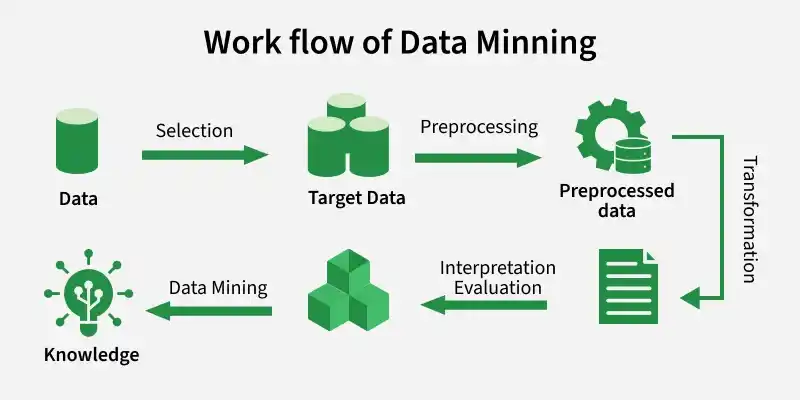
Data mining generally involves several stages. Each stage contributes to the quality and usefulness of the final results.
1. Data Collection
The first step is gathering relevant information from different sources. These sources may include databases, websites, customer surveys, mobile applications, transaction records, and business software.
The quality of the collected data matters because incomplete or inaccurate information can lead to misleading conclusions.
2. Data Cleaning
Raw data often contains errors, duplicate records, missing values, or inconsistent formats. Data cleaning helps identify and correct these problems before analysis begins.
For example, a customer database may contain the same person’s details multiple times. Removing unnecessary duplicates can improve the accuracy of the analysis.
3. Data Preparation
After cleaning, the information is organized into a suitable format. This may involve combining datasets, selecting relevant variables, and converting information into a form that analytical tools can process.
Proper preparation makes it easier to identify meaningful patterns.
4. Applying Data Mining Techniques
At this stage, analysts use suitable techniques and algorithms to explore the prepared data. The method depends on the problem being investigated.
For example, clustering can group similar customers together, while classification can help predict whether a transaction belongs to a particular category.
5. Evaluating Results
Not every pattern discovered in a dataset is useful. Analysts must evaluate the results to determine whether the findings are accurate, relevant, and meaningful.
They also need to consider whether the discovered relationships are genuine or simply coincidences.
6. Using the Insights
The final stage involves applying the results to real-world decisions. Organizations may improve marketing campaigns, adjust prices, identify risks, or redesign services based on the insights they discover.
Data mining becomes valuable when its findings help solve actual problems.
Common Techniques Used in Data Mining
Different data mining techniques serve different purposes. Understanding the main methods makes it easier to see how this technology works in practice.
Classification
Classification is used to place data into predefined categories. A model learns from existing examples and uses that knowledge to classify new information.
For instance, an email service may classify incoming messages as spam or legitimate email. Banks can also use classification models to assess whether transactions appear suspicious.
Clustering
Clustering groups similar records together without requiring predefined categories. It is particularly useful when organizations want to discover natural groups within their data.
A business might use clustering to divide customers into groups based on purchasing habits, interests, or spending patterns. These groups can help the company develop more relevant marketing strategies.
Association Rule Mining
Association rule mining identifies items or events that frequently occur together. It is commonly used in retail and recommendation systems.
For example, a supermarket may discover that customers who purchase pasta frequently purchase pasta sauce as well. The retailer can use this relationship to improve product placement or create suitable offers.
Regression Analysis
Regression is used to estimate relationships between variables and predict numerical outcomes. Businesses may use regression models to estimate sales, forecast demand, or examine how prices influence customer purchases.
Although regression can support predictions, its results depend on the quality of the data and the assumptions of the model.
Anomaly Detection
Anomaly detection identifies records or activities that differ significantly from normal patterns. It can be useful for detecting financial fraud, unusual network activity, equipment failures, and data entry errors.
An unusual event is not necessarily harmful, so additional investigation may be required before taking action.
Benefits of Data Mining
Data mining offers several advantages to organizations that know how to use it effectively.
One major benefit is improved decision-making. Instead of relying entirely on assumptions, businesses can examine actual evidence and identify patterns that support their choices.
Another advantage is a better understanding of customers. By analyzing purchasing behavior, feedback, and preferences, companies can develop products and services that more closely match customer needs.
Data mining can also help reduce operational costs. Organizations may discover inefficient processes, unnecessary expenses, and areas where resources are being wasted. Addressing these problems can improve productivity.
Risk identification is another important benefit. Financial institutions can use data mining to detect suspicious transactions, while manufacturers can identify patterns associated with equipment problems.
In addition, data mining supports forecasting. Historical information can help organizations estimate future demand, prepare inventory, and plan their budgets. These forecasts are not always correct, but they can provide useful guidance when combined with professional judgment.
Applications of Data Mining in Different Industries
Data mining is used across many industries because nearly every organization generates information that can be analyzed.
Banking and Finance
Banks analyze transaction histories to detect unusual activities and identify potential fraud. Data mining can also support credit risk assessment, customer segmentation, and financial planning.
By identifying suspicious patterns earlier, financial institutions can investigate potential problems more efficiently.
Healthcare
Healthcare organizations use data mining to study patient records, treatment outcomes, and disease trends. These insights may help researchers identify risk factors and support healthcare planning.
However, medical data requires special protection, and analytical findings should not replace professional medical judgment.
Retail and E-Commerce
Online stores use data mining to understand customer interests, recommend products, and estimate demand. Retailers can also examine sales patterns to improve inventory management.
For example, if sales records show increased demand for certain products during a particular season, a retailer can prepare stock in advance.
Education
Educational institutions can analyze attendance, examination results, and learning activity to identify students who may need additional support.
Teachers and administrators can use these findings to improve learning materials and develop more effective teaching strategies. Student information must be handled responsibly to protect privacy.
Marketing
Marketing teams use data mining to identify customer segments, evaluate campaign performance, and understand purchasing behavior.
Instead of sending the same message to everyone, a company can create more relevant campaigns for different groups of customers.
Manufacturing
Manufacturers can analyze production data to identify defects, monitor equipment performance, and improve quality control. Data mining may also help identify patterns that appear before machinery fails.
This information can support preventive maintenance and reduce unexpected downtime.
Data Mining vs. Data Analysis
Data mining and data analysis are closely related, but they are not exactly the same.
Data analysis is a broad term that includes examining, organizing, interpreting, and presenting information to answer questions. It can involve simple calculations, reports, visualizations, statistical tests, and advanced models.
Data mining focuses more specifically on discovering hidden patterns, relationships, and potentially useful structures within datasets. It often uses automated algorithms and machine learning methods to explore information at scale.
For example, calculating a company’s total monthly revenue is a basic data analysis task. Discovering groups of customers with similar buying habits or identifying unusual sales patterns is more closely associated with data mining.
In practice, the two activities frequently work together. Data analysts may use data mining techniques to discover patterns and then interpret the findings through further analysis.
Challenges and Limitations of Data Mining
Despite its benefits, data mining comes with several challenges.
Data quality is one of the most common problems. If the information is incomplete, outdated, or inaccurate, the results may be unreliable. Organizations must invest time and resources in preparing their datasets.
Privacy is another major concern. Personal information can reveal sensitive details about individuals, especially when multiple datasets are combined. Organizations should collect only necessary information, restrict access, and follow applicable privacy laws.
Data mining can also produce biased results. If historical data reflects unfair treatment or excludes important groups, a model may repeat those problems. Regular testing and careful evaluation are necessary to reduce this risk.
Another limitation is that patterns do not always explain cause and effect. Two variables may appear related without one directly causing the other. Making decisions based on an incorrect interpretation can lead to poor outcomes.
Finally, successful data mining may require skilled professionals, suitable software, computing resources, and ongoing maintenance. Smaller organizations may find these requirements difficult to manage.
Understanding these limitations helps organizations use data mining more responsibly and realistically.
The Future of Data Mining
The future of data mining is closely connected to artificial intelligence, machine learning, cloud computing, and the growing availability of digital information.
As analytical tools become more accessible, businesses of different sizes will be able to explore their data without necessarily maintaining expensive computing infrastructure. Automated systems may also make it easier to identify unusual patterns and generate useful forecasts.
Another important development is the increasing focus on responsible data use. Organizations will need to balance the benefits of advanced analytics with privacy, fairness, transparency, and security.
Data mining is also likely to become more useful for analyzing information from different sources, including text, images, sensors, and digital transactions. This can create new opportunities in healthcare, transportation, agriculture, education, and environmental monitoring.
However, technology alone will not guarantee good decisions. Human expertise remains essential for understanding context, checking results, and deciding how insights should be applied.
Conclusion
Data mining has become an important tool for understanding large amounts of information and turning them into practical insights. By identifying patterns, relationships, trends, and unusual activities, it helps organizations improve decisions, understand customers, manage risks, and plan for the future.
Its applications extend across banking, healthcare, retail, education, marketing, and manufacturing. Techniques such as classification, clustering, regression, association rule mining, and anomaly detection allow professionals to investigate different types of problems.
At the same time, data mining requires careful attention to data quality, privacy, bias, and the limitations of predictive models. When used responsibly, it can help individuals and organizations make better-informed decisions and gain greater value from the information they already possess.
As digital information continues to grow, data mining will remain an important part of modern data-driven decision-making.
Frequently Asked Questions (FAQs)
1. What is data mining in simple words?
Data mining is the process of examining large amounts of information to discover useful patterns, relationships, and trends. It helps people make better decisions based on evidence.
2. What is the main purpose of data mining?
The main purpose of data mining is to extract useful knowledge from data. Organizations use it to understand customer behavior, predict possible outcomes, detect risks, and improve their operations.
3. What are the main techniques of data mining?
Common techniques include classification, clustering, association rule mining, regression analysis, and anomaly detection. Each technique serves a different purpose depending on the problem and the type of data.
4. Where is data mining used?
Data mining is used in banking, healthcare, education, retail, e-commerce, marketing, manufacturing, telecommunications, and many other industries.
5. What is the difference between data mining and machine learning?
Data mining focuses on discovering useful patterns and insights from data. Machine learning develops algorithms that learn patterns from data to make predictions or decisions. The two fields overlap because machine learning is often used in data mining.
6. What are the major benefits of data mining?
Major benefits include better decision-making, customer insights, improved forecasting, fraud detection, cost reduction, risk identification, and more efficient business operations.
7. What are the main challenges of data mining?
The main challenges include poor data quality, privacy concerns, biased results, high implementation costs, and difficulties in interpreting complex patterns correctly.
8. Is data mining a good career field?
Data mining can be a valuable career direction for people interested in data and technology. Relevant skills include statistics, SQL, Python, data visualization, machine learning, and critical thinking. Career opportunities depend on experience, industry demand, and the ability to solve practical problems.