
Introduction
In the world of machine learning, data plays a major role in determining how well a model performs. However, collecting a large amount of data is not enough to achieve accurate results. Data must be prepared, organized, and transformed into a format that a machine learning algorithm can understand. This is where feature engineering becomes important.
Feature engineering is one of the most valuable steps in the machine learning process. It helps data scientists identify useful information, create meaningful variables, and improve the performance of predictive models. Even a powerful algorithm may produce poor results when the input data is incomplete, irrelevant, or poorly structured.
For example, an online store may have information about customers, including their purchase dates, order amounts, and browsing activities. By transforming this information into features such as average spending, purchase frequency, and days since the last order, a business can better understand customer behavior.
In this guide, we will explore what feature engineering is, why it matters, its main techniques, common challenges, and practical ways to use it effectively.
What Is Feature Engineering?
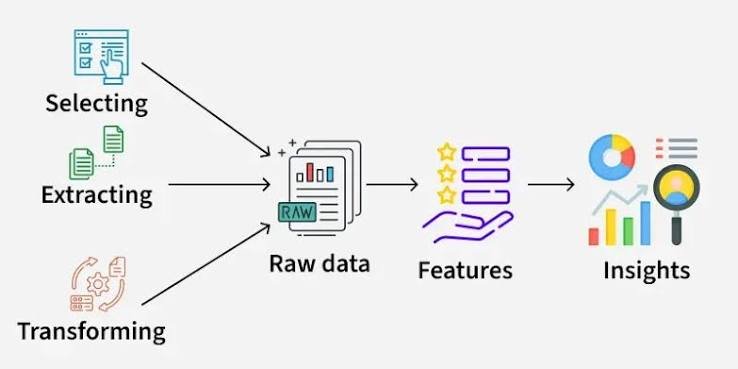
Feature engineering is the process of selecting, transforming, and creating input variables, known as features, to help machine learning models identify patterns and make better predictions.
A feature is an individual piece of information used by a model. For example, in a house price prediction system, features might include the property’s location, number of bedrooms, total area, age, and distance from the nearest school.
Some features are already available in a dataset, while others need to be created from existing information. The purpose of feature engineering is to make the data more useful for the problem being solved.
Consider a business that wants to predict whether a customer will stop using its services. The original dataset might contain subscription dates, payment records, customer complaints, and support requests. Instead of using these values without modification, a data scientist could create features such as the number of complaints in the last month, average monthly spending, and subscription duration.
These new features can reveal patterns that might otherwise remain difficult to identify.
Why Is Feature Engineering Important?
Feature engineering matters because machine learning models depend heavily on the quality and representation of their input data. Well-designed features can make important patterns easier to recognize, while poor features may introduce noise and confusion.
Here are some major benefits of feature engineering.
1. Improves Model Performance
Useful features help algorithms identify relationships between variables and the target outcome. For example, a loan approval model may benefit from a debt-to-income ratio rather than relying only on income and total debt as separate values.
2. Makes Data Easier to Understand
Feature engineering can turn complicated raw data into meaningful information. A timestamp, for instance, can be converted into the day of the week, month, hour, or season. These features may help a model identify changes in customer activity over time.
3. Reduces Unnecessary Information
Not every variable contributes to a useful prediction. Removing irrelevant or repetitive features can reduce complexity and sometimes improve model performance.
4. Supports Better Business Decisions
Engineered features often have practical meanings that business teams can understand. Customer lifetime value, average order size, and repeat purchase rate are examples of features that can support marketing and sales decisions.
Common Feature Engineering Techniques
There is no single technique that works for every dataset. The best approach depends on the type of data, the machine learning algorithm, and the objective of the project.
1. Handling Missing Values
Real-world datasets often contain missing information. A customer record may not include age, a product listing may have no rating, or a transaction may lack a delivery date.
Missing values can be handled in different ways. Numerical values may be replaced with the mean or median, while categorical values may be filled with the most frequent category or a separate label such as “Unknown.”
Sometimes, creating an additional feature that indicates whether a value was missing can also be useful. However, the chosen method should reflect the reason the information is missing and the requirements of the model.
2. Encoding Categorical Data
Machine learning algorithms often require categorical information to be represented numerically.
For example, a dataset might contain product categories such as clothing, electronics, and furniture. One-hot encoding converts these categories into separate binary columns. Label encoding assigns numerical labels to categories, although those numbers should not be interpreted as meaningful rankings unless the categories have a genuine order.
Choosing the right encoding technique helps prevent the model from misunderstanding categorical information.
3. Feature Scaling
Features may have very different numerical ranges. A person’s age might range from 18 to 80, while annual income could range from thousands to millions.
Feature scaling brings numerical values onto comparable scales. Standardization adjusts values using their mean and standard deviation, while min-max scaling transforms values into a specified range, often between zero and one.
Scaling is particularly important for algorithms such as k-nearest neighbors, support vector machines, and many gradient-based models. Tree-based algorithms generally require less scaling.
4. Creating New Features
Creating new variables from existing data is one of the most powerful feature engineering techniques.
For example, a retail business can calculate average order value by dividing total revenue by the number of orders. A subscription company can calculate customer tenure from the registration date. A delivery service can calculate delivery duration using dispatch and arrival timestamps.
These features provide information that may be more directly connected to the prediction target than the original variables.
5. Date and Time Feature Extraction
Dates and timestamps contain useful information that is not always obvious in their original format.
A date can be converted into features such as month, weekday, weekend indicator, hour, or quarter. For time-dependent problems, these features can help identify seasonal trends, peak activity periods, and changes in user behavior.
For example, an online food delivery platform might discover that order volume increases during weekends and evening hours. A model can use these patterns to improve demand forecasts.
6. Feature Selection
Feature selection involves identifying the most useful variables and removing those that contribute little value.
Common methods include correlation analysis, statistical tests, recursive feature elimination, and model-based importance scores. Regularization techniques can also discourage models from relying too heavily on unnecessary variables.
Feature selection may improve interpretability, reduce training costs, and help limit overfitting. However, features should not be removed simply because they have a low individual correlation with the target; some variables become valuable when considered alongside others.
The Feature Engineering Process
A structured process makes feature engineering easier to manage and evaluate.
Step 1: Understand the problem. Define the prediction target and determine what information is available when the prediction must be made.
Step 2: Explore the dataset. Examine data types, missing values, distributions, unusual observations, and relationships between variables.
Step 3: Clean and prepare the data. Correct inconsistent formats, handle missing information, and investigate potential errors.
Step 4: Create and transform features. Apply relevant encoding, scaling, aggregation, and feature extraction techniques.
Step 5: Select useful features. Use domain knowledge and appropriate statistical or model-based methods to identify valuable variables.
Step 6: Train and evaluate the model. Compare performance using suitable metrics and validation data that reflects the real prediction task.
Step 7: Refine the features. Review errors, test alternative transformations, and keep changes that improve reliable performance.
Feature engineering is usually an iterative process. Data scientists often return to earlier steps as they learn more about the problem and the model’s behavior.
Practical Example of Feature Engineering
Imagine an e-commerce company wants to predict whether a customer will make another purchase within the next 30 days.
The original dataset contains customer IDs, order dates, product prices, quantities, and payment information. These raw columns provide useful details, but they may not fully describe each customer’s shopping habits.
The data scientist can create several features:
- Total spending: The total amount spent by a customer during a defined period.
- Purchase frequency: The number of orders placed during the previous 90 days.
- Average order value: Total spending divided by the number of orders.
- Days since last purchase: The time elapsed since the customer’s most recent order.
- Product variety: The number of distinct product categories purchased.
- Recent activity: Whether the customer placed an order during the previous 30 days.
These features summarize customer behavior in a form that may help a classification model estimate the likelihood of another purchase.
The company can then compare the model’s performance before and after feature engineering. If the new features improve results on an appropriate validation dataset, they may provide meaningful value.
One important detail is that every feature must be calculated using information available at prediction time. Otherwise, the model could accidentally learn from future information and produce misleading results.
Common Challenges in Feature Engineering
Although feature engineering can improve machine learning results, it also introduces several challenges.
Data Leakage
Data leakage occurs when information that would not be available during real-world prediction enters the training process. For example, using a customer’s cancellation date to predict whether that customer will cancel creates an unrealistic advantage.
To prevent leakage, features must respect the timing of the prediction, and preprocessing steps should be fitted using training data only.
Overengineering
Creating too many features can increase complexity, introduce noise, and make a model harder to maintain. Every new feature should have a reasonable purpose and be evaluated rather than added automatically.
Domain Knowledge Limitations
Understanding the business context is often necessary to create meaningful features. A feature that appears useful statistically may have little practical meaning, while an important relationship may be overlooked without subject-matter knowledge.
Changing Data Patterns
Customer preferences, market conditions, and user behavior can change over time. Features that once worked well may become less predictive. Regular monitoring and periodic evaluation help identify these changes.
Best Practices for Effective Feature Engineering
To get the most value from feature engineering, follow a few practical principles.
- Start with a clear understanding of the business problem and prediction target.
- Explore the data before deciding which transformations to apply.
- Use domain knowledge to create features that represent meaningful relationships.
- Build preprocessing steps into a repeatable pipeline.
- Prevent data leakage by respecting training, validation, and prediction timelines.
- Compare changes using suitable evaluation metrics rather than assumptions.
- Keep useful features understandable, maintainable, and consistent in production.
- Document important decisions so that other team members can reproduce the results.
Automation tools can help with repetitive tasks, and automated feature engineering can generate candidate variables. However, human judgment remains valuable for selecting features that make sense for a specific problem.
Conclusion
Feature engineering is a fundamental part of building reliable machine learning systems. It transforms raw information into meaningful variables that help algorithms identify patterns, make predictions, and support informed decisions.
From handling missing values and encoding categories to creating behavioral metrics and extracting information from dates, feature engineering offers many ways to improve data quality and model usefulness.
Its success depends on understanding the problem, selecting appropriate techniques, avoiding data leakage, and evaluating every important change. More features do not automatically produce better results. The real goal is to create a smaller or more informative representation of the data that helps a model perform reliably on unseen examples.
Whether you are working on customer analytics, fraud detection, sales forecasting, or recommendation systems, learning feature engineering can strengthen your machine learning skills and help you build more effective data-driven solutions.
Frequently Asked Questions (FAQs)
1. What is feature engineering in machine learning?
Feature engineering is the process of selecting, transforming, and creating variables from raw data to help machine learning models make more accurate and useful predictions.
2. Why is feature engineering important?
It helps models identify relevant patterns, improves data representation, reduces unnecessary information, and can improve predictive performance when the features are appropriate for the problem.
3. What are some examples of feature engineering?
Common examples include calculating customer age from a birth date, creating an average purchase value, extracting weekdays from timestamps, encoding product categories, and scaling numerical variables.
4. What is the difference between feature engineering and feature selection?
Feature engineering creates or transforms variables to make them more useful, while feature selection identifies which existing or engineered variables should be retained for modeling.
5. Which tools are commonly used for feature engineering?
Popular tools include Python, pandas, NumPy, and scikit-learn. Depending on the project, data scientists may also use SQL, Spark, or specialized automated feature engineering libraries.
6. Does feature engineering improve every machine learning model?
No. Its impact depends on the dataset, algorithm, and prediction task. Some transformations improve performance, while others may add noise or provide little benefit. Testing is necessary to determine their value.
7. What is data leakage in feature engineering?
Data leakage happens when a model receives information that would not legitimately be available during prediction. It can make evaluation results appear better than actual real-world performance.
8. Can beginners learn feature engineering?
Yes. Beginners can start by learning data cleaning, missing-value handling, categorical encoding, numerical scaling, and date extraction. Practicing these techniques with small datasets is an effective way to develop practical skills.