
Introduction to Transfer Learning
Transfer learning is an important concept in machine learning that allows a model to use knowledge gained from one task to improve its performance on another related task. Instead of training a model from scratch, developers can start with a model that has already learned useful patterns from existing data. This approach can save time, reduce computational costs, and improve results when only a limited amount of training data is available. Transfer learning is widely used in artificial intelligence, computer vision, natural language processing, and speech recognition. As machine learning continues to develop, transfer learning is becoming an effective way to build smarter and more efficient AI systems.
1. What Is Transfer Learning?
Transfer learning is a machine learning technique in which knowledge acquired from one problem is applied to a different but related problem. A model trained on a large dataset can learn useful features that may also be valuable for another task. For example, a model trained to recognize different objects in images may later be adapted to identify specific types of plants. This process reduces the need to collect large datasets and train complex models from the beginning. Transfer learning is particularly useful when the target task has limited labeled data or requires faster development. It helps researchers and developers build effective models with fewer resources.
2. How Does Transfer Learning Work?
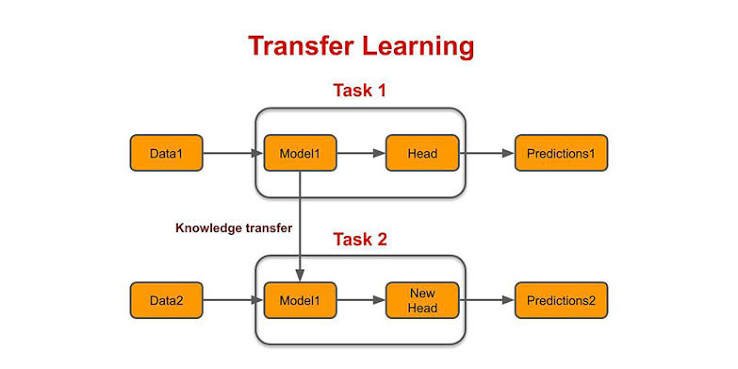
Transfer learning usually begins with a pretrained model that has already learned patterns from a large dataset. The developer then adapts this model to a new task by changing its output layer, adjusting selected parameters, or training some of its existing layers. During this process, the model uses its previously learned features while gradually learning information specific to the new problem. Some applications require only a small amount of additional training, while others benefit from more extensive fine-tuning. The exact method depends on the similarity between the original task and the target task. When applied carefully, transfer learning can make model development faster and more practical.
3. Types of Transfer Learning
There are several approaches to transfer learning, and each serves a different purpose. Inductive transfer learning is used when the target task differs from the source task, but labeled or useful training information is available for the target. Transductive transfer learning focuses on applying knowledge to a target domain that differs from the source domain, often when target labels are limited or unavailable. Unsupervised transfer learning applies learned representations to tasks that do not depend on labeled data. In practical machine learning projects, pretrained models, feature extraction, and fine-tuning are also common strategies. Selecting the appropriate approach depends on the available data, model architecture, and project objectives.
4. Transfer Learning in Deep Learning
Transfer learning plays a significant role in deep learning because neural networks often require substantial amounts of data and computing power. Models trained on large datasets can learn meaningful representations, such as edges, shapes, textures, language patterns, and relationships between words. These learned representations can be reused for related tasks instead of starting with randomly initialized parameters. For instance, a pretrained convolutional neural network can be adapted to classify medical images, while a pretrained language model can be customized for text classification. This technique can reduce training requirements and help improve performance. However, the benefits depend on whether the pretrained model is suitable for the target problem.
5. Applications of Transfer Learning in Computer Vision
Computer vision is one of the most common fields where transfer learning is applied. Pretrained image models can be adapted for object detection, facial recognition, image classification, and defect identification. In healthcare, transfer learning may support the analysis of medical images, including scans and photographs, when suitable training data is available. In agriculture, it can help identify plant diseases or distinguish between different crop conditions. Businesses can also use transfer learning to inspect products and detect manufacturing defects. These applications demonstrate how previously learned visual features can support specialized tasks. Nevertheless, models must be evaluated carefully to ensure reliable results in their intended environments.
6. Transfer Learning in Natural Language Processing
Natural language processing uses transfer learning to help computers understand, classify, and generate human language. Pretrained language models learn linguistic patterns from large collections of text and can later be adapted to specific applications. Examples include sentiment analysis, spam detection, document classification, question answering, and customer support systems. Instead of teaching a model language from the beginning, developers can build on its existing knowledge and train it for a particular purpose. This can improve efficiency and reduce the amount of task-specific data required. However, the quality of the results still depends on the training data, model selection, and evaluation process.
7. Benefits of Transfer Learning
One of the main benefits of transfer learning is that it reduces the time and resources needed to train machine learning models. Since a pretrained model already contains useful learned representations, developers may need less data and fewer training iterations to achieve acceptable performance. Transfer learning can also improve results on smaller datasets, where training a model from scratch may lead to overfitting. It makes advanced machine learning techniques more accessible to researchers, students, and businesses with limited computing resources. Additionally, it supports the reuse of existing models across related applications. Although these advantages can be substantial, the final performance depends on how well the source knowledge matches the target task.
8. Challenges and Limitations of Transfer Learning
Despite its advantages, transfer learning has several limitations that developers should understand. A major challenge is negative transfer, which occurs when knowledge from the original task reduces performance on the new task. Differences between source and target datasets can also affect accuracy and reliability. Some pretrained models are large and require considerable memory, processing power, or specialized hardware. There may also be concerns about data privacy, bias, licensing, and the suitability of the original training data. Fine-tuning a model without proper validation can produce misleading results. To address these challenges, developers should select suitable pretrained models, examine the target dataset, and test performance using relevant evaluation metrics.
9. Transfer Learning vs. Traditional Machine Learning
Traditional machine learning often requires a model to learn patterns specifically from the dataset associated with the target problem. Depending on the method, the developer may need to create features, collect sufficient training examples, and train the model for the intended task. Transfer learning takes a different approach by reusing knowledge learned from an existing model. This can make it more efficient when the new task is related to the original one. However, traditional training may be more appropriate when no suitable pretrained model exists or when the target problem has very different characteristics. The best choice depends on data availability, computational resources, model requirements, and expected performance.
10. Feature Extraction and Fine-Tuning
Feature extraction and fine-tuning are two common techniques used in transfer learning. In feature extraction, the pretrained model is used to generate useful representations, while most or all of its learned parameters remain unchanged. A new classifier or task-specific component is then trained using those representations. This approach is often faster and can work well when the available dataset is small. Fine-tuning involves updating some or all of the pretrained model’s parameters using data from the target task. It can help the model adapt more closely to the new problem, although it may require additional computation and careful parameter selection. Developers choose between these methods based on their data, objectives, and resources.
11. Best Practices for Using Transfer Learning
Successful transfer learning begins with selecting a pretrained model that matches the target task and data characteristics. Developers should examine the model’s original training dataset, architecture, licensing conditions, and intended uses before adopting it. The target dataset should be cleaned, appropriately labeled, and divided into training, validation, and test sets. During fine-tuning, a suitable learning rate can help preserve useful pretrained knowledge while allowing meaningful adaptation. Performance should be compared against a reasonable baseline rather than assumed to improve automatically. It is also important to monitor overfitting, class imbalance, and potential bias. Careful evaluation helps determine whether transfer learning genuinely benefits the application.
12. Future of Transfer Learning
The future of transfer learning is closely connected to the growth of foundation models, multimodal AI, and more efficient machine learning methods. Researchers are developing models that can transfer knowledge between different types of information, including text, images, audio, and video. These advances may make it easier to adapt general-purpose models to specialized industries and new languages. Parameter-efficient fine-tuning methods are also helping reduce the computing resources needed to customize large models. In the coming years, transfer learning may support more accessible AI tools in education, healthcare, manufacturing, and scientific research. Its continued success will depend on responsible data use, reliable evaluation, and careful adaptation to real-world requirements.
Conclusion
Transfer learning is a valuable machine learning technique that allows developers to reuse knowledge from existing models for new, related tasks. It can reduce training time, lower computational costs, and improve performance when target datasets are limited. Its applications extend across computer vision, natural language processing, healthcare, agriculture, and many other fields. However, selecting an appropriate pretrained model and evaluating its performance remain essential for achieving reliable results. Challenges such as negative transfer, dataset differences, and model bias must also be considered. Overall, transfer learning provides a practical foundation for developing efficient and adaptable artificial intelligence systems.
Frequently Asked Questions (FAQs)
1. What is transfer learning in simple words?
Transfer learning means using knowledge learned by a machine learning model from one task to help it perform another related task. It reduces the need to train a model entirely from scratch.
2. What are the main benefits of transfer learning?
The main benefits include faster training, reduced computational costs, less dependence on large labeled datasets, and potentially better performance on specialized tasks.
3. Where is transfer learning commonly used?
Transfer learning is widely used in computer vision, natural language processing, medical image analysis, speech recognition, agriculture, and many other artificial intelligence applications.